
Quick answer
One kilometre per hour is 0.621371 miles per hour, so to convert kmh to mph you divide by 1.609344. A 100 kmh limit is 62 mph. Type your figure above and the answer appears immediately, with knots and metres per second also in the dropdowns.
Converting speed in three steps
Enter the speed
Type into the left box. The answer updates as you type.
Pick the two units
Kilometres and miles per hour are preset. Switch for knots or metres per second.
Read or swap
The answer is on the right. Press the swap arrows to reverse the direction.
mph = km/h ÷ 1.609344The same factor as miles to kilometres, because both are distance over the same hour.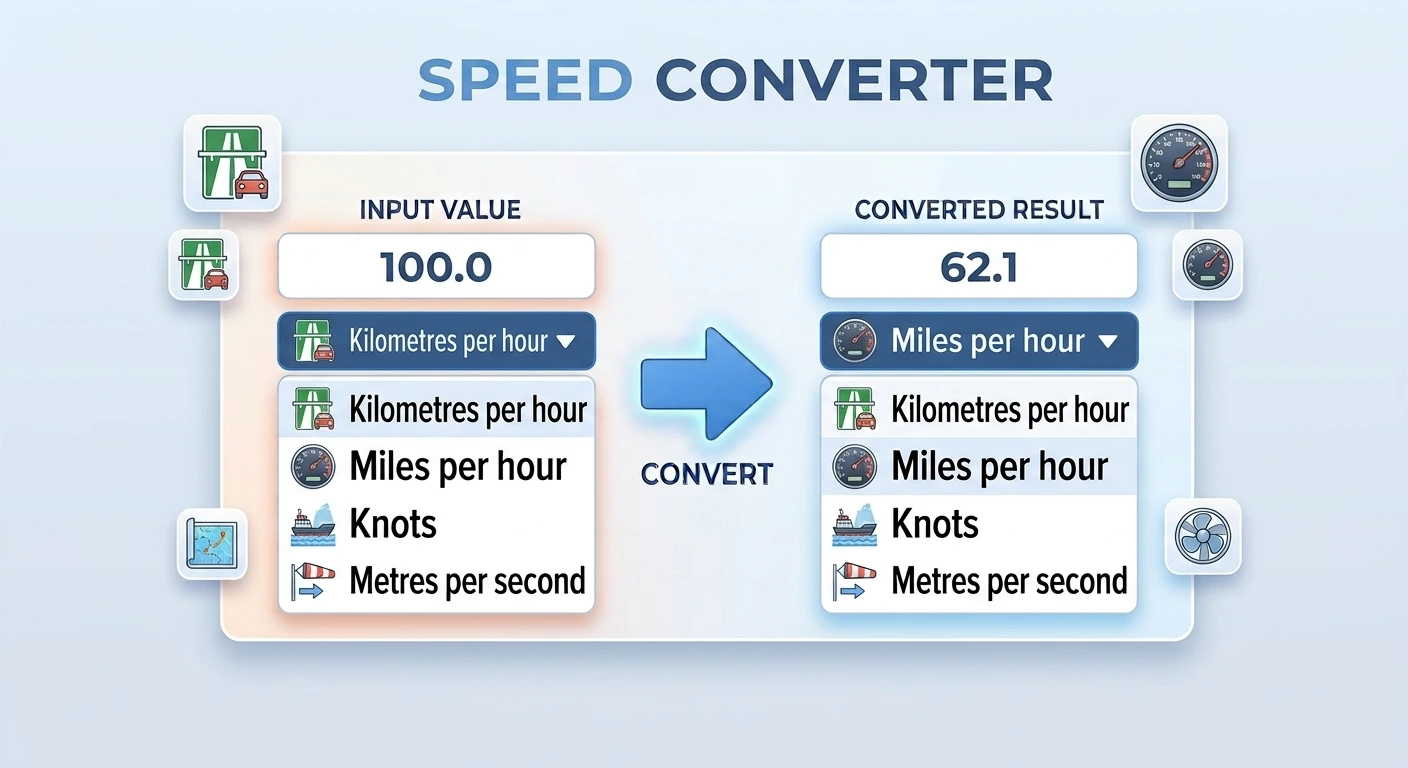
kmh to mph and the road signs that matter
Speed limits are the everyday reason for this conversion. Converting kmh to mph is a division by 1.609344, so the common European limits map to familiar numbers: 50 becomes 31 mph, 100 becomes 62, and 130 becomes 81. A rough mental method is to take away a third, which puts 90 kmh at about 60 mph against a true 55.9. Good enough to avoid a shock, not good enough to rely on.
mph to kmh for hire cars and imported dials
Going from mph to kmh means multiplying by 1.609344. It matters if you are driving an imported car with a miles-only speedometer through a metric country, or reading an American speed figure while working in metric. A 70 mph motorway limit is 112.7 kmh, and 30 mph in a built up area is 48.3 kmh.
knots to mph for sailing and aviation
A knot is one nautical mile per hour, and a nautical mile is 1,852 metres, which makes a knot 1.15078 mph. Converting knots to mph comes up with marine forecasts, aviation reports and storm coverage, since all three report wind in knots. A 40 knot gale is 46 mph or 74 kmh. The unit survives because a nautical mile maps neatly onto a minute of latitude, which still matters for navigation.
metres per second, the one science uses
Metres per second is the SI unit, so it is what turns up in physics problems and engineering specifications even though nobody uses it for driving. To get from kmh, divide by 3.6. That makes 100 kmh equal to 27.8 m/s. The converter above handles it alongside feet per second, which appears in older American engineering work.
Common speed conversions
| From | To | Result |
|---|---|---|
| 10 km/h | mph | 6.21 mph |
| 50 km/h | mph | 31.07 mph |
| 100 km/h | mph | 62.14 mph |
| 130 km/h | mph | 80.78 mph |
| 30 mph | km/h | 48.28 km/h |
| 70 mph | km/h | 112.65 km/h |
| 1 knot | mph | 1.1508 mph |
| 40 knots | mph | 46.03 mph |
| 100 km/h | m/s | 27.78 m/s |
Why choose our speed converter
Free and unlimited
No account, no sign up, no daily cap.
Runs in your browser
Nothing is sent to a server, so it works offline once loaded.
Every unit in one place
Swap either side and the whole category is in the dropdowns.
Instant on mobile
Results update as you type, with no page reload.
Speed questions
What is 100 kmh in mph?+
Is there a quick mental method?+
Why do ships and aircraft use knots?+
What is the difference between kph and kmh?+
Why did my old page redirect here?+
Does this work offline?+
Related converters
Need a different unit?
The universal converter covers length, weight, temperature, volume, speed, area, data and time.
Open the universal converter